
Home Composting Explained: Palm Leaf vs Bagasse
Understanding how natural materials break down at home is essential for event planners and hosts committed to zero-waste practices.
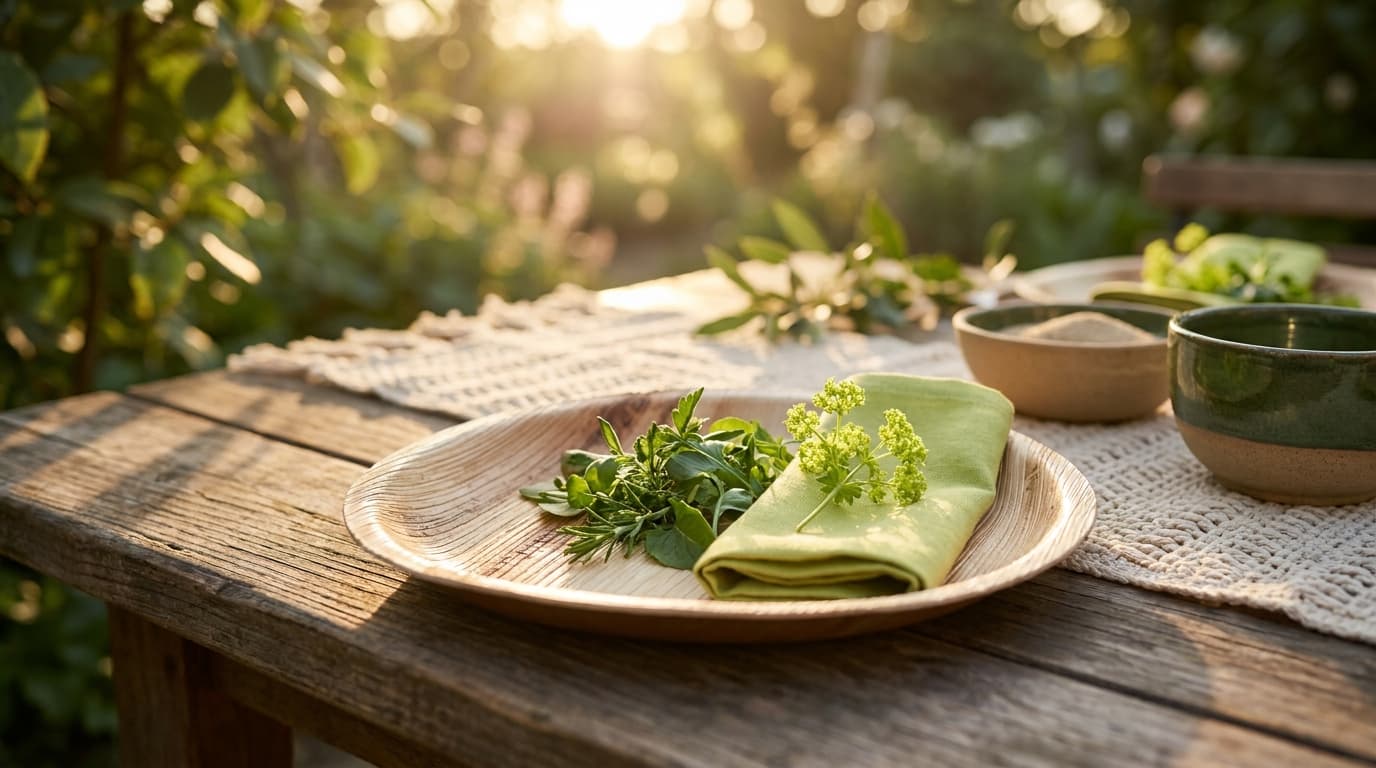
Home composting offers a genuine pathway to circularity for event waste, yet the performance of materials varies significantly. Areca palm leaf, a minimally processed natural fiber, typically breaks down in home systems within 45 to 60 days. Conversely, bagasse, or sugarcane fiber, is a versatile material that may require 90 to 180 days to decompose depending on its thickness and density. Understanding these timelines is vital for those choosing compostable tableware for weddings and catered events.
Home Composting Palm Leaf vs Bagasse
When we discuss home composting, we refer to the natural breakdown of organic matter under ambient temperatures, usually between 20°C and 40°C. According to European Bioplastics, this process differs fundamentally from industrial composting, which relies on high-heat, controlled environments—often reaching 55°C to 65°C—to accelerate the degradation of complex polymers and dense fibers.
For the conscious host, selecting areca palm leaf means choosing a material that returns to the soil with minimal intervention. These products are crafted from naturally fallen leaves that are heat-pressed into shape, meaning there are no additional glues, resins, or chemical additives that would inhibit biological decay. Provided the items are shredded into smaller pieces and integrated into a balanced pile of "greens" (nitrogen-rich waste like food scraps) and "browns" (carbon-rich materials like dry leaves or cardboard), the material acts as a carbon source, enriching the soil with organic matter as it disappears.
Bagasse, derived from the fibrous pulp left over after sugarcane stalks are crushed to extract juice, remains an excellent sustainable choice for catering and foodservice. However, its structural integrity—often a benefit for serving heavier meals—can sometimes lead to a longer composting cycle. The density of bagasse products is engineered to withstand hot liquids and oily foods, a feature that translates to a slower microbial digestion process at home. To ensure success, users should be aware that while uncoated bagasse is highly compatible with home composting, any item with specialized coatings—such as those designed to be leak-proof for long-term liquid storage—may necessitate a longer duration or access to an industrial facility. As noted by BioPak, the distinction between commercial and home-ready materials is rooted in rigorous testing regimes. Proper identification of your specific product type is the first step toward effective waste management, ensuring that "compostable" labels translate into real-world results rather than logistical hurdles.
Operational Integrity in Waste Management
For professional event planners and venue managers, integrity in sustainability messaging is paramount. Relying on generic compostable labels without understanding the breakdown requirements can lead to "wish-cycling." This occurs when items are incorrectly disposed of or sent to systems where they cannot effectively decompose, resulting in them occupying landfill space rather than becoming nutrient-rich compost. By providing accurate disposal guidance to guests—such as clear signage near disposal bins—you move beyond performative actions toward a measurable, circular impact. Incorporating areca palm round plates or bagasse round plates into your event design allows for a clear, transparent sustainability strategy that clients can actually track and verify.
To optimise the decomposition process, consider the physical preparation of the tableware before it enters the bin. Shredding larger items into two to three-inch pieces dramatically increases the surface area available to beneficial microbes, bacteria, and fungi. Maintaining consistent moisture (roughly the consistency of a wrung-out sponge) and aerating the pile by turning it regularly are also necessary steps to ensure aerobic microbial activity. Without adequate oxygen, the pile can turn anaerobic, producing methane—a potent greenhouse gas—rather than the stable, nutrient-dense humus desired in home composting. This level of intentionality transforms waste management from a logistical burden into a positive contribution to the local ecosystem, effectively closing the loop on event-based consumption.
| Feature | Areca Palm Leaf | Bagasse (Sugarcane) |
|---|---|---|
| Decomposition Time | 45–60 days | 90–180 days |
| Processing | Minimally processed (heat-pressed) | Fiber-pressed (pulp extraction) |
| Ideal Environment | Home composting | Home or Industrial |
| Preparation | Shredding recommended | Shredding recommended |
| Carbon-to-Nitrogen | High (Brown) | Moderate (Brown) |
| Structural Density | High | Variable (ranges from light to heavy) |
When comparing these two, it is also useful to look at the Global Foodservice Management (GFM) standards for sustainable procurement. The following table highlights how these materials align with standard event management sustainability goals:
| GFM Sustainability Criterion | Areca Palm Leaf | Bagasse (Sugarcane) |
|---|---|---|
| Renewable Raw Material | Yes (fallen leaves) | Yes (agricultural byproduct) |
| Energy-Intensive Production | Very Low | Low-Moderate |
| Additive-Free | Yes | Generally (check for coatings) |
| Circularity Potential | High (Home Garden) | High (Industrial/Commercial) |
By taking the time to understand these materials, you can offer clients and guests a truly sustainable experience that aligns with modern environmental standards. Whether you are hosting a rustic, low-impact wedding using areca palm trays—which provide a unique, wood-like aesthetic—or a large-scale corporate event with bagasse compartment trays designed for high-volume service, your knowledge of material lifecycles ensures that your commitment to the planet is both visible and authentic.
Effective waste management is as much about education as it is about materials. When event planners communicate the "why" and "how" behind their choice of tableware, it influences guest behaviour long after the event has concluded. Many guests, upon seeing that a plate can return to their own garden soil within two months, are encouraged to adopt home composting practices in their personal lives. This ripple effect expands the benefit of your event's sustainability strategy far beyond the boundaries of the venue itself.
It is also worth noting that the "compostability" of these items provides an opportunity for venues to divert significant volumes of organic waste from municipal collection services. By managing organic waste on-site or through local composting partners, venues can reduce their carbon footprint associated with waste transport and methane emissions in landfills. As you refine your approach, remember that the "perfect" material often depends on the specific culinary application. Areca is exceptional for its visual appeal and rapid turnover in home piles, while bagasse offers the robust utility required for diverse catering needs, from soups to hot entrees. We invite you to explore our full range of compostable tableware to find the perfect fit for your next gathering, ensuring that every plate used serves as a stepping stone toward a more circular and sustainable future.
Frequently asked questions
What is the primary difference between home and industrial composting?
Home composting occurs at ambient temperatures (20–40°C), whereas industrial composting uses high-heat, controlled environments to break down organic materials more rapidly.
How should I prepare tableware for my home compost pile?
To accelerate decomposition, it is recommended to shred areca palm and bagasse items into 2–3 inch pieces and ensure they are layered with nitrogen-rich materials.
Do all compostable products break down in the same amount of time?
No. Areca palm leaves generally break down within 45–60 days, while bagasse can take anywhere from 90 to 180 days, depending on the thickness and processing of the material.
What is wish-cycling in the context of compostable ware?
Wish-cycling occurs when items are placed in a composting bin in the hope that they will break down, even if they are not suitable for that specific system, which can contaminate the end compost.
Sources
- biopolylab.com — biopolylab.com
- ecopulppack.com — ecopulppack.com
- notpla.com — notpla.com
- shreeimpex.com — shreeimpex.com
- bioleaderpack.com — bioleaderpack.com
Set a beautiful table — then compost it.
More from Composting & Zero Waste
Home Compostable Tableware: Decoding True Sustainability
Understanding the vital distinction between home and industrial composting is the first step toward genuine sustainable hosting and authentic zero-waste events.
Read · 5 min→Home compostable tableware: A guide to authentic sustainability
Navigating the complexities of composting certifications ensures your events truly support circularity rather than contributing to landfill waste.
Read · 5 min→Home Compostable Tableware: A Guide to Authentic Sustainability
Distinguishing between industrial and backyard degradation is the most critical step in professional sustainable procurement for modern events.
Read · 5 min→